May 20, 2026
By Ganesh Mannamal, Founder at Parsec Flow Studios
How Contractors Rank Higher in Google Maps
Learn how contractors rank higher in Google Maps using Google Business Profile categories, reviews, citations, website authority, and geo-grid ranking checks.
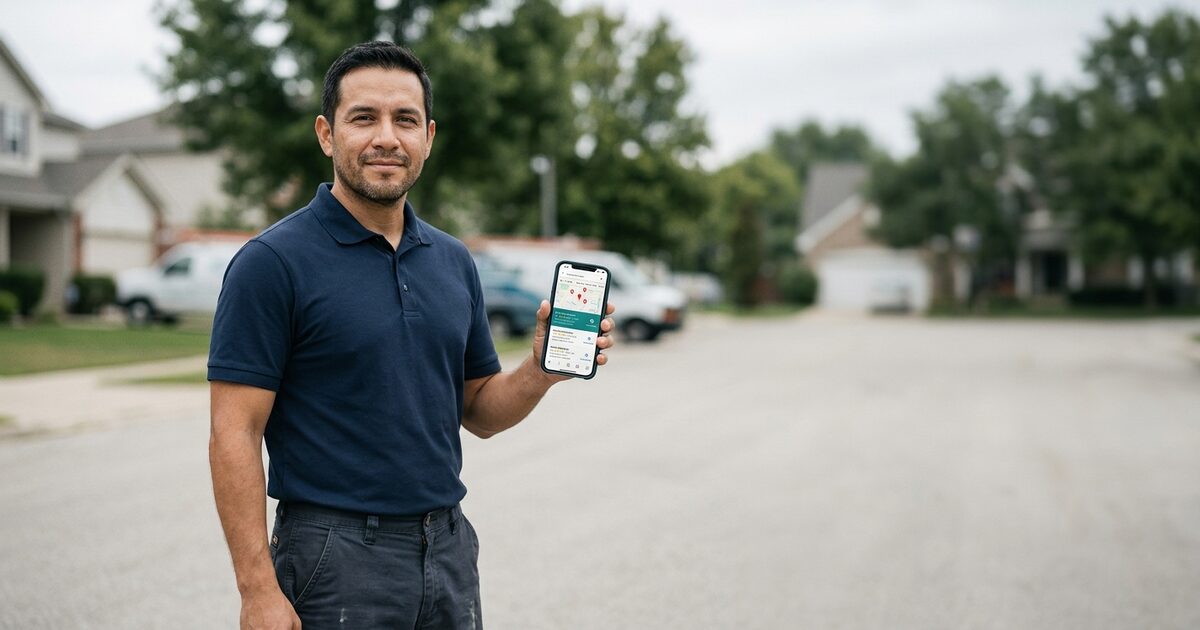
It is 9pm and a homeowner’s furnace stops working. They search “emergency furnace repair near me.” Three contractors appear in the map pack. One of them gets the call. The others (businesses that may be closer, more experienced, or better reviewed) are not visible at that moment and do not get considered.
That gap is not always about who does better work. Google can only rank what it can measure. Many contractors have strong reputations built on years of completed jobs, but have never actively managed the inputs that tell Google their business is active, relevant, and trusted in a specific area.
Most of those inputs are within a contractor’s control. This article explains how Google’s local ranking works, which factors matter, and what practical steps tend to improve visibility, without overstating what is guaranteed.
Key Takeaways
- Google officially bases local rankings on three factors: Relevance, Distance, and Prominence.
- Distance is the one factor you cannot change directly. Relevance and Prominence are within reach.
- Primary category is one of the highest-impact settings in a GBP listing. A generic primary category makes everything else harder.
- Review recency can be a major factor in competitive local markets, especially when nearby competitors are also earning fresh reviews.
- Many established contractors are losing visibility to competitors who manage their profile more consistently, not because those competitors do better work.
- Map pack rankings vary by the searcher’s physical location. There is no single position, only a range across the service area.
Why Your Map Pack Position Isn’t Random
The local map pack, those three business listings that appear above organic results for searches like “plumber near me” or “AC repair [city],” is sorted by an algorithm, not by years in business or volume of jobs completed.
Google’s goal is to return the most relevant result for the searcher at that moment. It evaluates every eligible GBP listing across ranking factors and surfaces the businesses that send the clearest combination of inputs for that query, from that location. The business at position 1 did not get there by being the best contractor in the city.
There is also no single rank to track. A contractor’s position changes based on where the searcher is standing, what exact phrase they typed, whether they are on mobile or desktop, and the competitive landscape in that specific area. A contractor who appears at position 1 in their main service area might appear at position 6 eight kilometres away, and not at all in an adjacent city.
Improving overall profile strength tends to lift visibility across the board, but the degree of improvement depends on the competitive environment and how consistently the work is done.
The Three Signals Google Uses to Rank in Maps
Google’s local ranking documentation describes three factors: Relevance, Distance, and Prominence. Understanding what each one means, and which ones are within reach, is the starting point for improving local visibility.
Relevance: Does Your Listing Match What They Searched?
Relevance measures how well a GBP listing matches the searcher’s query. Google needs to be reasonably confident the business does what the person is looking for.
The primary category carries significant weight here. According to Google’s business information guidance, your primary category describes your core business. If you are a plumber but the primary category is set to “Home Services” or “Contractor,” Google has less confidence you are the right result for “plumber near me.” The primary category should be the most specific, accurate match for your core service: “Plumber,” “HVAC Contractor,” “Electrician,” not a broad parent category. The Whitespark GBP categories guide covers how to select and evaluate primary categories in detail, and is worth reviewing before making changes.
Category changes can affect visibility, so make them intentionally. Moving from a generic to a specific primary category typically helps. Switching between unrelated categories should be done carefully.
Beyond primary category, these profile fields also affect relevance:
- Additional categories: GBP supports up to 9 secondary categories. Add every relevant one. If you do HVAC installation and furnace repair, list both. Secondary categories should reflect services your business actually provides, not keyword stuffing.
- Business description: 750 characters to describe what you do, where you work, and who you serve. Use natural language that includes your main service types and service area.
- Services section: each service can have a name and description. Most contractors leave this blank or use generic entries. Completing it with specific service names (“Water heater installation,” “Emergency drain cleaning,” “Panel upgrade”) helps Google understand what the business actually offers.
- Products section: if this feature is available and appropriate for your profile type, it can be used for installable equipment, packages, or common service offerings. Do not force a retail-style product catalog if that is not how your business actually sells. For most service contractors, categories, description, and services are higher priority.
Distance: How Close Is Your Business to the Searcher?
Distance measures the physical proximity of your business location (or defined service area) to the person searching. All else being equal, Google tends to surface closer results.
This is the one factor that cannot be changed directly. What matters is understanding how it applies to your situation.
If you have a physical storefront or office address, Google knows your location precisely and can rank you for nearby searches. Being in a dense urban area means strong proximity within that zone, but more competition.
If you are a service-area business (SAB) (like most plumbers, HVAC contractors, and electricians who work from a home address or warehouse), you can hide your address while setting defined service areas. According to Google’s GBP guidelines, service-area businesses should set service areas based on the cities or regions where they actually serve customers.
For service-area businesses, proximity can be harder to diagnose because the public address is hidden and rankings vary heavily across the service area. What tends to compensate is being meaningfully stronger on Relevance and Prominence relative to nearby competitors.
One important clarification: adding more service areas to a GBP listing does not automatically improve rankings across all those areas. Service area settings tell Google where your business is eligible to appear, not where it will rank. Prominence and relevance still determine where, within eligible areas, the listing actually surfaces.
Prominence: Does Google Trust Your Business?
Prominence is Google’s measure of how well-known and reputable a business is. It has the most moving parts, and the most room for improvement.
Review count and star rating. More reviews generally support visibility. A higher average rating generally helps. The relationship is more nuanced than simply accumulating reviews over time.
Review recency and consistency. Research from Sterling Sky on review recency suggests that recent reviews may carry more weight than older ones in competitive local searches. A contractor who received 10 reviews over the past 60 days is signalling active, current engagement. One with 80 reviews, all from two or more years ago, may be signalling an operation that stopped asking. In practice, a plumber or HVAC company with fewer total reviews but a steady flow of recent, specific ones can sometimes outrank a competitor with a larger but stale profile, particularly in markets where nearby businesses are also accumulating fresh reviews. Whitespark has also identified review recency as an underrated local ranking factor.
Build a simple review request process after each completed job. A text message with a direct link to your GBP review form gets higher completion than asking in person or by email. Do not offer incentives for reviews, and do not ask customers to include specific keywords. Both practices violate Google’s guidelines and undermine genuine feedback. For a full breakdown of how reviews affect both ranking and conversion — including how to build a consistent flow and what a healthy profile looks like — see how reviews drive more local customers.
Review responses. Responding to reviews is something Google explicitly recommends. While it may not function as a standalone ranking lever, responding to reviews (especially negative ones) supports trust, profile activity, and conversion. Most contractors respond to few or none. Responding consistently takes minimal time once it becomes a routine.
Citation consistency. A citation is any online mention of your business name, address, and phone number (NAP). Google cross-references GBP data against other directories: Yelp, BBB, HomeStars, Yellow Pages, local chamber listings. Inconsistencies (different phone numbers, old addresses, name variations) reduce confidence in your business data. Consistent information across key directories strengthens that clarity.
Website authority. Your GBP listing connects to your website. If the website has links from reputable local sources (trade associations, supplier directories, chamber listings, local media), that credibility supports broader prominence. Thin sites that describe services in three sentences can limit trust and conversion even when the GBP listing is getting impressions.
📋 Free: GBP Optimization Checklist
Trade-specific checklist covering categories, photos, posts, reviews, and Q&A. Seven editions for HVAC, plumbing, electrical, roofing, and more.
Get the checklist →What Google’s Guidelines Say vs. What Local SEO Testing Shows
It is worth being clear about what is confirmed guidance versus what is practitioner observation.
Google’s local ranking documentation confirms that local results are based on three main factors: relevance, distance, and prominence. It also notes that complete and accurate business information, genuine reviews and ratings, and broader web presence influence local visibility. Those are the officially confirmed inputs.
Within those broad categories, local SEO practitioners, including researchers at Whitespark and Sterling Sky, test more specific factors: primary category selection, review velocity, citation consistency, website relevance to service queries, and proximity patterns across service areas. Their findings inform practical recommendations, but they are not the same as official Google policy.
The distinction matters for how you act on advice. Official Google guidance gives you the baseline. Practitioner testing suggests which activities tend to move the needle in competitive local markets, but results vary by location, trade, and what competitors are doing.
The practical direction for any contracting business is not to chase ranking hacks. It is to make the business easier for Google to understand, trust, and match to service-area searches. A complete and accurate GBP, a consistent review flow, a website that describes real services clearly, and accurate citations across key directories are the foundations. Everything more tactical builds on top of them.
What Actually Moves the Needle (In Priority Order)
Most articles about GBP give you a checklist. This is a priority sequence: the actions with the highest practical impact, in the order they should be done.
1. Confirm your primary category is correct. Log into your GBP dashboard and verify the primary category is the most specific accurate match for your core service. “Plumber” not “Home Services.” “HVAC Contractor” not “Contractor.” For most contractors who have not reviewed this recently, it is the single highest-leverage change available.
2. Get new reviews over the next 30 days. Even with a solid existing review count, fresh reviews signal active, current business. Send a review request to recent customers after each completed job. A text message with a direct link to your GBP review form gets higher completion than asking in person or by email.
3. Complete your services section with specific descriptions. Each service can have a name (“Furnace repair,” “Emergency plumbing,” “Panel upgrade”) and a description of up to 300 characters. Use natural language that includes the service type and city where it fits naturally. Most contractors leave this blank.
4. Respond to every review. Set aside time to respond to all unanswered reviews. Keep responses brief and professional. For negative reviews, acknowledge the issue without arguing. Going forward, respond within a day or two of each new review.
5. Audit your NAP consistency across major directories. Search your business name and check that the name, address, and phone number on Yelp, BBB, HomeStars, and Yellow Pages match your GBP listing exactly. Inconsistencies (even minor ones like “St.” vs “Street” or an old phone number) create noise in the consistency picture.
6. Build 2–3 citations from relevant directories. Being listed in trade-specific directories (HomeAdvisor, Angi, Houzz), your local chamber of commerce, and supplier directories (the contractor locator on a major HVAC or plumbing brand’s website) adds legitimate prominence. A small number of relevant citations matters more than a large number of generic ones.
7. Make sure your website supports your GBP. A contractor trying to rank for “water heater installation” or “roof leak repair” should have a relevant page or section on their website describing that service. GBP impressions do not convert well when the website is a thin homepage with no service specifics. See why contractor websites often fail to convert leads for what to address.
📘 Free: Local SEO Blueprint for Contractors
A practical 30-day plan to improve local visibility, Google Business Profile, and website conversion, built for HVAC, plumbing, roofing, and other home service businesses.
Get the blueprint →What We Check in a Contractor Google Maps Audit
What we review in a local visibility audit
When we audit a contractor’s local visibility, we look at: primary category selection, secondary categories, service area configuration, review velocity and recency, review response rate, GBP completeness (photos, Q&A, services, posts), service-page relevance on the website, citation consistency across key directories, and geo-grid visibility across the actual service area, not just a single search from a single location.
That combination shows where the gaps are and what is worth addressing first. If you want to see how your business measures up, the Free Local Growth Audit runs through the same checks in about 90 seconds.
Why a Competitor With Fewer Jobs Ranks Above You
This is the question most established contractors eventually ask. You have been in business for 12 years, completed hundreds of service calls, and your work quality is well above average, yet a company operating for three years is consistently appearing above you in the map pack.
The answer is usually a visibility gap. The newer competitor has:
- A complete and regularly-updated GBP profile
- A steady flow of recent reviews, because they ask for them after every job
- Consistent citation data across directories
- Someone who responds to reviews promptly
You have done more work, but you have not yet managed the inputs that tell Google your business is active, credible, and relevant in your service area. Google does not know about the service calls you have completed. It only measures what it can observe.
The gap is closeable. Some profile improvements can show results relatively quickly, but meaningful ranking changes across a service area usually take consistent effort over several weeks or months. The competitor’s current visibility advantage is not built on years of accumulated authority. It is based on a few specific habits you have not yet built.
This pattern shows up repeatedly across HVAC companies, plumbing businesses, electricians, roofers, appliance repair companies, and other home service trades. The businesses ranking well in the map pack are rarely the most experienced in the area. They are the ones maintaining their profile most consistently.
How to Know Where You Actually Stand
Map pack position is not a single number. It varies by location, keyword, and device across a service area.
Why one Google Maps search is not enough
Google Maps rankings change by searcher location. A contractor may look strong from one point and nearly invisible from another. Example range for a plumber based in one neighbourhood:
| Search location | Example ranking |
|---|---|
| Near business base | Position 2 |
| 3 km away | Position 5 |
| 7 km away | Position 11 |
| Adjacent city | Not in top 20 |
A single search from one device (especially one logged into your own Google account) does not reflect this range. Geo-grid checks show where the business actually appears across its full service area.
The most practical way to assess actual visibility is a geo-grid rank check: a tool that searches for your business from multiple points across your service area and maps where you appear. This gives you a real picture of coverage across the service footprint, not just the view from one location.
Tracking rank position alone is also incomplete. The metrics that matter for a contracting business are calls, form submissions, and booked appointments. A business at position 3 with a weak website or slow response process will lose jobs to a competitor at position 4 with a faster, clearer conversion path.
If you are not sure why your contracting business is missing from Google Maps, start with the Free Local Growth Audit. We check your Google Business Profile, local ranking inputs, website conversion path, and service-area visibility so you can see what is holding back calls and estimate requests.
For a broader look at how Maps ranking fits into the full local visibility picture, see the complete guide to local SEO for contractors.
Ganesh Mannamal
Founder, Parsec Flow Studios
Ganesh Mannamal is the founder of Parsec Flow Studios, a local growth agency that helps home service businesses improve Google visibility, website conversion, and lead response systems. Parsec Flow audits Google Business Profiles, service pages, review performance, local visibility, and conversion paths for contractors across Ontario and North America.
Google Maps Ranking FAQ for Contractors
How does Google decide which contractors rank in the map pack?
What is the most important Google Business Profile setting for contractors?
How many reviews does a contractor need to rank higher in Google Maps?
Why does my Google Maps ranking change by neighbourhood?
Can a service-area business rank without showing its address?
How long does it take for Google Maps SEO to work?
See how your business ranks
We'll review your Google Business Profile, service pages, and local visibility, then show you practical opportunities to improve rankings and turn more local searches into calls.
Get Your Free Audit